Overview
The Devil Wears Prada 2 is a 2026 American comedy-drama film directed by David Frankel from a screenplay by Aline Brosh McKenna, both returning from the 2006 original. Meryl Streep, Anne Hathaway, Emily Blunt and Stanley Tucci reprise their roles, joined by Kenneth Branagh, Justin Theroux, Lucy Liu, B. J. Novak, Simone Ashley and others. Produced by Wendy Finerman and distributed by 20th Century Studios, the film opened in the United States on 1 May 2026 after premieres in Tokyo, Seoul, Shanghai, New York and London. It runs 119 minutes.
Set twenty years after the first film, the sequel finds Andrea “Andy” Sachs established as a respected journalist, Miranda Priestly still ruling Runway but constrained by modern media and HR departments, and Emily Charlton transformed into a senior executive at Dior. When Runway is rocked by a sweatshop-labour controversy, owner Irv Ravitz hires Andy as features editor behind Miranda's back. What follows is a battle over the future of fashion journalism, the value of print and the meaning of loyalty in an industry being rewritten by technology.
The film was a major commercial success. On a reported budget of $100 million, it grossed approximately $693.5 million worldwide, including $220.6 million in the United States and Canada. Reviews were generally favourable: Rotten Tomatoes records 78% positive from 346 critics, and Metacritic gives it 63/100. Audience response was stronger still, with a CinemaScore of A−. The film also attracted controversy over a supporting character's name and portrayal, and over aspects of its Italian dubbing.
This article is an independent reference work. It summarises publicly available reporting and reference sources, with links to the original material. Plot details are discussed openly in the story section, which is marked as containing spoilers.
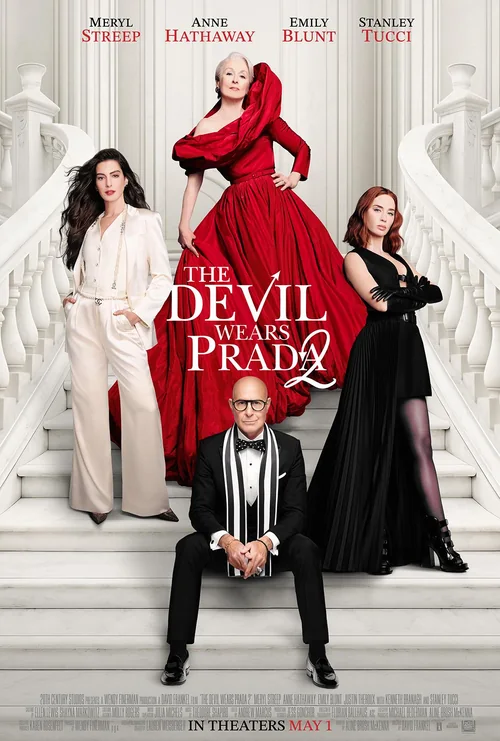
Quick facts
- Director
- David Frankel
- Writer
- Aline Brosh McKenna
- Producer
- Wendy Finerman
- Release
- 1 May 2026 (US)
- Runtime
- 119 minutes
- Studio
- Wendy Finerman Productions
- Distributor
- 20th Century Studios
- Music
- Theodore Shapiro
- Cinematography
- Florian Ballhaus
- Editing
- Andrew Marcus
- Budget
- $100 million
- Worldwide gross
- $693.5 million
- Lead cast
- Meryl Streep, Anne Hathaway, Emily Blunt
- IMDb
- tt33612209 · 6.3/10
The original film and the long gap
Why a sequel took twenty years
The Devil Wears Prada was released in 2006 and became a defining workplace comedy for a generation. Adapted from Lauren Weisberger's novel, it followed Andy Sachs, a naive journalism graduate who takes a job as second assistant to the terrifying editor-in-chief Miranda Priestly. The film was a commercial and cultural success, turning Meryl Streep's Miranda into one of cinema's most quoted characters and establishing a sharp, funny language for discussing ambition, status and self-respect.
For years, a sequel seemed doubtful. The original ended with Andy walking away from Runway and Miranda acknowledging, in a rare moment of honesty, that Andy reminded her of herself. That ending felt complete. Interest renewed as the cast's careers evolved and the fashion magazine industry itself underwent a dramatic transformation — from print authority to digital precarity, from editorial gatekeeping to influencer economics and, latterly, generative AI.
Development began in July 2024, when Disney, the parent of 20th Century Studios, became interested in a follow-up. David Frankel and Aline Brosh McKenna returned, and the principal cast agreed to reprise their roles. The project was fast-tracked to the point that Disney moved Avengers: Doomsday from the 1 May 2026 date to make room for it.
The premise
Rather than repeat the original's fish-out-of-water story, the sequel asks what happens when the people who once occupied fixed roles have all changed positions. Andy is now the experienced journalist; Emily is the corporate executive; Miranda is the veteran facing a world that no longer automatically obeys her. The title's continuity is thematic: the devil still wears Prada, but the industry around her has been rewritten.
Casting and production
The returning ensemble
Meryl Streep returns as Miranda, now married to Stuart Simmons, played by Kenneth Branagh. Anne Hathaway plays Andy, a respected journalist whose newsroom is closed by text message at the start of the film. Emily Blunt's Emily Charlton has become a senior executive at Dior, and Stanley Tucci's Nigel remains Miranda's closest professional ally. The four leads reportedly received equal upfront salaries of $12.5 million each plus backend participation — a pay-parity arrangement that drew attention given Streep's decades of seniority.
New cast members include Justin Theroux as Benji Barnes, Lucy Liu as his ex-wife Sasha, B. J. Novak as Jay Ravitz, Simone Ashley as Miranda's current first assistant Amari Mari, and Patrick Brammall as Peter, Andy's love interest. Lady Gaga appears as a fictionalised version of herself, and a long list of fashion and media figures cameo as themselves, including Donatella Versace, Marc Jacobs, Naomi Campbell, Heidi Klum and Tina Brown.
Filming and design
Principal photography ran from 30 June to 20 October 2025 in Manhattan, Milan and Newark, New Jersey. New York locations included Kaufman Astoria Studios, 1221 Avenue of the Americas, the Dior boutique on Madison Avenue, the Waldorf Astoria lobby, Hudson Yards and the American Museum of Natural History. Italian filming took place at Palazzo Parigi, the Accademia di Brera, Lake Como and Villa del Balbiano.
Production designer Jess Gonchor returned from the first film and rebuilt the Runway offices at eight times the size of the original sets — a visual statement about the magazine's corporate expansion. A sequence at Santa Maria delle Grazie used a three-quarters-scale set with a hand-painted replication of Leonardo da Vinci's Last Supper, illustrating the production's preference for physical craftsmanship over purely digital environments.
Plot
Spoiler notice: this section describes the complete plot, including the ending.
Two decades later
Andy has become a respected global journalist in New York, but her newsroom is abruptly laid off by text message during an awards ceremony. Miranda faces a different crisis: Runway has published a puff piece about a fashion brand accused of using sweatshop labour. Irv Ravitz, chairman of parent company Elias-Clarke, hires Andy as features editor without telling Miranda, hoping she can restore the magazine's credibility.
Miranda struggles with modern media — clickbait, cheap short-form content, advertiser pressure and the HR complaints that now limit the imperious behaviour that once defined her. She is, however, happily married to Stuart. Emily, now a senior executive at Dior, uses the Runway controversy to secure free advertising and a Dior article. Miranda assigns the interview to Andy, and the two spar over modern fashion, high retail prices and the exclusion of middle-class consumers.
A magazine under threat
Andy gains influence after securing an interview with Sasha Barnes, the reclusive ex-wife of Silicon Valley billionaire Benji Barnes. Irv promises Miranda a global head-of-content promotion but dies of a heart attack before announcing it. His son Jay takes over, delays the promotion and brings in consultants to cut costs. Andy's personal life stalls as she dismisses Peter's work as an apartment renovator while worrying about her own future; she considers writing a tell-all about Miranda.
During Milan Fashion Week, Andy tries to save Runway by finding a wealthy patron to buy it from Jay. That patron turns out to be Benji, Emily's boyfriend, who may replace the magazine's staff with AI. Miranda and Andy instead convince Sasha to buy all of Elias-Clarke, stopping Benji and Emily's plan. Sasha gives Miranda the promotion Irv had promised.
The ending
Miranda asks Nigel to deliver the gala keynote, a long-overdue acknowledgement of his years of service. She tells Andy that her idealism inspired Miranda to fight back, and encourages her to write the tell-all, including Miranda's flaws. Andy reconciles with Peter and Emily; Nigel reveals that he was the one who persuaded Irv to rehire her. Miranda returns to work with renewed imperiousness and gives Andy a better office. The film ends by confirming that neither woman has become someone else — they have simply learned how to use their power differently.
Cast and characters
| Actor | Character | Role in the story |
|---|---|---|
| Meryl Streep | Miranda Priestly | Editor-in-chief of Runway |
| Anne Hathaway | Andrea “Andy” Sachs | Journalist and new features editor |
| Emily Blunt | Emily Charlton | Senior executive at Dior |
| Stanley Tucci | Nigel Kipling | Miranda's longtime ally |
| Kenneth Branagh | Stuart Simmons | Miranda's husband |
| Justin Theroux | Benji Barnes | Emily's boyfriend and tech billionaire |
| Lucy Liu | Sasha Barnes | Benji's ex-wife and potential saviour |
| B. J. Novak | Jay Ravitz | Heir to Elias-Clarke |
| Simone Ashley | Amari Mari | Miranda's current first assistant |
| Patrick Brammall | Peter | Andy's love interest |
| Tracie Thoms | Lily | Andy's friend |
| Lady Gaga | Herself (fictionalised) | Figures in Miranda's past |
Themes and interpretation
Old media versus new media
The sequel's central conflict is not a romance or a career ladder but an industry in transition. Runway is caught between the authority of print and the economics of clicks, between editorial judgement and advertiser pressure. The proposed AI replacement of the staff makes that anxiety literal. The film asks whether an institution with history can survive when its audience and its owners no longer value the skills that built it.
Power, age and relevance
Miranda is no longer the youngest person in the room, and the film is alert to what that means. She has been constrained by HR complaints and mocked online; her authority now has to be asserted rather than assumed. Streep plays this without sentimentality. Miranda remains formidable, but the source of her power has shifted from fear to experience — and the film suggests that experience may be the more durable asset.
Mentorship and recognition
The relationship between Miranda and Andy is the emotional centre. In the first film, Andy rejected Miranda's world; here she returns to it as a peer. The ending, in which Miranda asks Nigel to deliver the keynote and tells Andy that her idealism inspired her, reframes both relationships as acts of recognition. The film is less interested in forgiveness than in acknowledging what people have given each other.
Ambition and integrity
Andy's possible tell-all raises the question of whether professional success requires personal compromise. She has become respected by leaving Runway, yet she returns because the magazine needs someone who understands both journalism and power. The film's answer is typically pragmatic: integrity is not a fixed position but a series of choices made under pressure.
Friendship as an unfinished business
Emily and Andy begin the sequel as near-strangers, their old intimacy distorted by career competition. Their reconciliation is one of the film's quieter satisfactions. Unlike the grand corporate battles, it depends on admitting that both people changed — and that change does not have to mean the end of a friendship.
Fashion, sets and visual style
The original film's costumes were famous for making fashion legible as character: Miranda's severity, Andy's gradual polish, Emily's precision. The sequel updates that language for an era of athleisure, luxury conglomerates and social-media branding. Andy's wardrobe is now assured rather than aspirational; Emily's reflects corporate authority; Miranda's remains a carefully maintained instrument of control.
The rebuilt Runway offices are eight times larger than the original set, a decision that gives the film a different visual rhythm. The first film's cramped corridors made Miranda feel omnipresent; the sequel's expansive newsroom makes the institution feel like a corporation under siege. Cinematographer Florian Ballhaus shoots both New York and Milan with a clean, high-key clarity that keeps the comedy bright even when the plot turns abrupt.
The Milan sequence, including the replicated Last Supper set, provides the film's most self-conscious visual moment. Placing a fashion thriller against one of the most famous images in Western art is both a joke about spectacle and a statement about the industry's hunger for iconic composition.
Music
Theodore Shapiro returned to compose the score after the first film. The soundtrack was released through 20th Century Studios and Interscope Records on the day of the North American debut. It includes a 20-track score album of roughly 39 minutes and several prominent songs.
The lead single, “Runway” by Lady Gaga and Doechii, was previewed in the second trailer on 6 April 2026 and released officially on 9 April. Lady Gaga also performs “Shape of a Woman” in the film and contributes “Glamorous Life”. Her appearance as a fictionalised version of herself connects the music to the story: both the songs and the cameo present fashion as a system that manufactures desire.
The score's role is more restrained. Shapiro's writing supports the film's comic timing and the quieter moments of recognition between the leads, avoiding the theatrical grandeur that might have turned a workplace comedy into a melodrama. The music was recognised with nominations including Grammy categories for “Runway” and the soundtrack compilation.
Release and marketing
The sequel had an unusually global premiere schedule: Tokyo on 6 April, Seoul on 8 April, Shanghai on 10 April, New York's Lincoln Center on 20 April and London on 22 April. The New York premiere was livestreamed on Disney+ and Hulu, an unusual promotional choice that extended the event beyond the invited audience. The film opened in 4,150 US theatres on 1 May.
Digital release followed on 30 June, with 4K Ultra HD and Blu-ray on 28 July, including a bundle with the first film, and streaming on Disney+ and Hulu from 29 July. The compressed window reflects both the film's broad appeal and Disney's integrated release strategy.
Marketing leaned on the return of the ensemble and on the visual language of the franchise: glossy posters, sharp one-liners and the implication that Miranda's authority had not diminished. The trailer featuring “Runway” gave the campaign a contemporary edge, connecting the older audience for the original with a younger one familiar with Lady Gaga and Doechii.
Box office
The film grossed approximately $693.5 million worldwide, with $220.6 million in the United States and Canada and $472.9 million internationally. Its opening day domestically was $32.5 million, including $10 million from Thursday previews, and its opening weekend was $76.7 million — the fourth-biggest debut of 2026 and a substantial improvement on the original film's $27.5 million 2006 opening.
Global opening day reached $114.6 million, with an international opening weekend of $156.6 million and a worldwide opening of $233.6 million. That was the second-best worldwide opening for a 2026 Motion Picture Association release, behind The Super Mario Galaxy Movie. By June, the film had passed $676 million worldwide.
Combined with the original's $327 million, the franchise crossed $1 billion worldwide. The result made the sequel the sixth-highest-grossing film of 2026 and confirmed that a twenty-year-old workplace comedy could still function as a global theatrical event when its cast and premise returned intact.
Critical reception
Reviews were generally favourable rather than rapturous. Rotten Tomatoes records 78% positive from 346 critics with an average rating of 6.6/10, and its consensus notes that Meryl Streep still wears Miranda “like a finely-tailored suit”. Metacritic scores the film 63/100 from 57 critics, described as generally favorable. IMDb users rate it around 6.3/10, while CinemaScore audiences gave it an A−, an improvement on the first film's B.
Positive reviews praised Streep's performance, the fashion-world charm and the film's observations about modern media. Justin Chang of The New Yorker wrote that the film is “selling a truckload of preposterous goods, but it sells them awfully well, with unfeigned assurance, conviction, and the appropriate ratio of cynicism to hope.” That assessment captures the film's appeal: it is knowingly artificial but emotionally precise.
Negative reviews focused on inconsistency. Moira MacDonald of The Seattle Times called it “flat champagne: maybe worth drinking in a pinch, but unsatisfying.” Some critics felt the corporate plot was too convoluted for a comedy, while others thought the film relied too heavily on the audience's affection for characters they already knew.
“The film understands that its audience does not want these people to change completely. It wants them to recognise how the world changed around them.”
Controversies
The Jin Chao character
A clip released on 16 April featured Andy's assistant Jin Chao, played by Helen J. Shen. Critics argued that the character relied on racist tropes, pointing to the name's resemblance to a slur, her dowdy clothing, glasses and recitation of academic achievements. The Asian American Foundation criticised what it described as the continuation of offensive stereotypes. Writer Aline Brosh McKenna responded that Jin Chao was named after a childhood friend and described her as a “very dimensional character” and a “love letter” to enterprising Gen Z assistants.
The disagreement is reported here neutrally. The film's broader comedy of status depends on exaggerated types, but the accusation concerned a specific character whose treatment many viewers felt crossed from parody into stereotype. It became the most public controversy of the release.
Italian dubbing
Some Italian viewers were dissatisfied with the Italian dub despite the return of the original voice actors. Maria Pia Di Meo, who voiced Meryl Streep's characters in Italian, was 86 at the time of release, and some viewers felt she sounded older than Miranda appeared on screen. Other complaints concerned synchronisation, because certain Italian lines took longer to deliver than the corresponding English dialogue.
Debates and open questions
Was the story necessary?
The original film ended decisively, and some critics questioned whether another chapter could justify itself. The sequel's answer is generational: the characters and the industry have both aged twenty years, and the shift from print authority to digital precarity gives the story a new subject. Whether the corporate plot earns its complexity remains a matter of opinion.
Miranda as mentor or antagonist?
The first film treated Miranda as an antagonist whose power was finally seen from the inside. The sequel moves her closer to mentor, particularly in the ending, where she credits Andy with inspiring her. Some viewers welcomed the softening; others felt it diluted what made the character compelling.
AI and the future of magazines
The plan to replace Runway's staff with AI is the film's most topical plot element. It functions as a threat rather than a detailed technological argument, but it gives the magazine's crisis a contemporary edge. Critics disagreed about whether the idea was integrated into the story or simply a buzzword inserted to make the conflict current.
The value of the cameos
With appearances from designers, models, athletes and media figures, the film sometimes resembles a fashion-industry roll call. Supporters saw the cameos as part of the world the film satirises; detractors found them distracting. The film's commercial performance suggests the strategy worked with audiences.
Legacy and franchise future
With a worldwide gross of $693.5 million, The Devil Wears Prada 2 pushed the franchise past $1 billion and demonstrated the enduring value of a well-cast ensemble comedy. Its opening exceeded the original's by a wide margin, and its audience grade was higher. In a market increasingly dependent on established intellectual property, the sequel became one of 2026's clearest examples of a dormant property revived successfully.
The film also reintroduced its characters to a generation that encountered the original through streaming and social media. “Runway” extended that reach through music channels, while the New York premiere's livestream created an event that crossed promotional boundaries.
No third film had been officially confirmed at the time of writing. The sequel's ending is comparatively open: Andy is encouraged to write the tell-all, Miranda has been reinvigorated and Emily is reconciled with her old friend. Those loose threads leave room for another chapter, though the twenty-year gap and the cast's schedules make timing uncertain.
The film's place in the broader revival of adult-oriented studio comedies is also significant. Its budget was close to three times the original's before inflation adjustment, yet its gross was more than double. That ratio is likely to be studied by studios weighing whether to revisit other well-loved properties from the 2000s. The answer the film offers is not simply nostalgia: the returning cast mattered, but so did giving them a world that had changed enough to make their old conflicts newly interesting.
Character focus
Andy Sachs: from assistant to equal
Anne Hathaway's Andy is no longer the overwhelmed newcomer. She is a journalist with a reputation, a relationship and a life outside Runway. Her return is therefore a choice rather than a necessity, and the film's best scenes come from watching her negotiate with people who still remember the assistant she used to be. Hathaway plays that history without nostalgia.
Miranda Priestly: power without youth
Meryl Streep's Miranda remains the film's attraction, but the performance has changed. She is still exacting, still capable of reducing a room with a sentence, and now constrained by procedures she once ignored. The ending's request that Nigel deliver the keynote is a small act of generosity that makes her more human without making her ordinary.
Emily Charlton: the assistant who became the executive
Emily Blunt's Emily has the most obvious transformation. Once defined by anxiety and rivalry, she now operates at corporate level and uses Runway's crisis to extract value for Dior. Her reconciliation with Andy gives the sequel its emotional payoff, suggesting that competition need not be the only language between women in the same industry.
Nigel and the overlooked
Stanley Tucci's Nigel has always been the film's quiet moral centre. In the sequel he is finally recognised, both by Miranda and by the audience. The revelation that he prompted Irv to rehire Andy reframes the entire plot as an act of quiet loyalty — a reminder that institutions often depend on people whose contributions are never formally acknowledged.
Comparison with the first film
The original The Devil Wears Prada was a coming-of-age story disguised as a workplace comedy. Andy arrived in New York knowing nothing about fashion and learned to read a room, a wardrobe and a boss before deciding that the lesson had gone far enough. Its emotional arc was linear: innocence, adaptation, compromise, departure. The sequel begins after all of that. Andy has already made her choice, and the film is interested in what choosing a life outside Miranda's orbit actually means twenty years later.
The tone changes accordingly. The 2006 film was sharper and more satirical, built on the absurdity of Miranda's demands and the escalating stakes of Andy's transformation. The sequel is broader and more melancholy, aware that its characters have become part of the establishment they once mocked. Runway is no longer simply a glamorous workplace; it is an institution with debt, consultants and a succession problem. The jokes remain, but they operate inside a more complicated world.
The visual scale also changes. The original's cramped offices made every interaction feel like a test of proximity — who could stand closest to Miranda, who was sent away. The rebuilt set is eight times larger, which alters the choreography. Characters now move through a newsroom that resembles a corporation, and the film's wide frames make the staff look small against the institution. That is a deliberate visual argument: the people have not changed as much as the structure around them.
Miranda herself is the clearest comparison. In the first film, her severity was almost mythic, a force that seemed to exist outside ordinary accountability. Here she is subject to HR complaints, online mockery and the impatience of a new owner's son. Streep does not soften her; she places her in a world that no longer has time for her particular kind of authority. The result is a performance about relevance rather than villainy.
Runway as an institution
The sequel treats Runway less as a workplace than as a organism under threat. Its crisis begins with an ethical failure — a puff piece about a brand accused of sweatshop labour — and escalates through ownership, advertising and staffing. The magazine's problem is not a single bad editor but a business model that has lost the trust that once made its judgement valuable.
Irv Ravitz represents the old proprietor: autocratic, informal and personally invested in the title. His son Jay represents the new owner: a financier who sees a magazine as an asset to be trimmed. Between them, Miranda and Andy occupy a shrinking space where editorial judgement is still meant to matter. Their alliance is therefore practical before it is emotional; both understand that the magazine cannot survive if it is reduced entirely to content output.
The AI subplot gives that anxiety a contemporary edge. Benji's plan to replace staff with automation is less a technological forecast than a caricature of a familiar corporate argument — that human expertise can be treated as a line item. The film does not develop the idea in detail, but it gives the conflict a clear shape: either the magazine is a place where people make judgements, or it becomes a system that generates material.
Sasha's decision to buy Elias-Clarke resolves the plot in the language of corporate power rather than sentiment. A woman who had every reason to stay out of the industry steps in precisely because she understands its value. That ending is characteristic of the sequel's realism: good outcomes arrive through ownership and leverage, not through a change of heart alone.
Awards and recognition
The film's awards profile reflects both its strengths and its commercial positioning. It won the Golden Trailer Award for Best Teaser for “Catwalk”, and the Berlin Commercial Festival recognised craftsmanship in costume styling for the “Runway” campaign. It was nominated in categories including Best Summer 2026 Blockbuster Trailer and several Grammy Awards, including Best Pop Duo/Group Performance and Best Song Written for Visual Media for “Runway”.
Emily Blunt received an Astra Midseason Movie Awards nomination for Best Supporting Actress, and the ensemble was recognised at the Kids' Choice Awards with nominations for Anne Hathaway, Emily Blunt and the pairing of Meryl Streep and Stanley Tucci. Those nominations illustrate the film's unusual breadth: it is a workplace comedy, a fashion satire, a music-video event and a star-driven ensemble piece all at once.
The film's most meaningful recognition, however, may be its audience grade. An A− CinemaScore represents a clear improvement on the original's B and suggests that viewers who loved the first film felt the sequel respected what they remembered about it.
A global premiere calendar
The release campaign began in Asia, with premieres in Tokyo on 6 April, Seoul on 8 April and Shanghai on 10 April. The New York premiere followed on 20 April at Lincoln Center, and London on 22 April. That sequence was unusual for an American comedy and reflected the franchise's strong international audience — particularly in markets where fashion and celebrity culture are major promotional channels.
The Lincoln Center premiere was livestreamed on Disney+ and Hulu, turning an industry event into a promotional broadcast. It also signalled Disney's confidence in the film as a platform property: the same services would later host the streaming release. The staggered calendar kept the film in news cycles for nearly a month before it reached theatres.
The US opening on 1 May placed the film at the start of the summer season. It opened in 4,150 theatres and earned $76.7 million in its first weekend, a figure that exceeded the original's entire opening by a wide margin. The subsequent digital and physical release schedule — 30 June, 28 July and 29 July — compressed the usual home-media window but preserved distinct moments for purchase, ownership and streaming.
Sources and further reading
- Wikipedia — The Devil Wears Prada 2: credits, plot, production, music, box office, reception and controversies.
- IMDb — tt33612209: rating, runtime and key art.
- Wikimedia Commons: freely licensed cast and location photography.
Editorial note: this is an independent reference article. It is not affiliated with 20th Century Studios, Disney or the film's rights holders. Image credits and the removal process are described on the DMCA page.
Frequently asked questions
What is The Devil Wears Prada 2?
It is a 2026 comedy-drama sequel directed by David Frankel, starring Meryl Streep, Anne Hathaway, Emily Blunt and Stanley Tucci. It is set twenty years after the original film.
When was it released?
The film premiered in several cities during April 2026 and opened in the United States on 1 May 2026.
How long is it?
The runtime is 119 minutes.
What is the plot?
Andy returns to Runway as features editor while Miranda fights to keep the magazine relevant amid corporate cuts, digital disruption and a possible AI takeover.
Who composed the music?
Theodore Shapiro composed the score. The lead single is “Runway” by Lady Gaga and Doechii.
How much did it earn?
Reported worldwide gross is $693.5 million against a $100 million budget, making it one of the biggest comedies of 2026.
What did critics say?
Reviews were generally favourable: 78% positive on Rotten Tomatoes and 63/100 on Metacritic. Audiences gave it an A− CinemaScore.
Was the film controversial?
Yes. A supporting character named Jin Chao drew criticism over alleged stereotypes, and the Italian dub was criticised by some viewers. Both are discussed neutrally in the controversies section.
Is a third film planned?
No third film had been officially confirmed at the time of writing.
Is this website official?
No. This is an independent informational reference site with no affiliation to Disney, 20th Century Studios or the filmmakers. Sources and an image-removal process are provided on the DMCA page.
Community
Join the discussion
Have a thought about the film or this article? Leave a comment. Your name is displayed, and if you add a website it will be linked with a
nofollowattribute. Basic HTML is supported:<p>,<strong>,<em>,<a>, lists and blockquotes.Comments update live. New posts appear automatically without refreshing.
No comments yet. Be the first to start the conversation.
By commenting you agree to the Terms of Use. See the Privacy Policy for how your data is handled.